
Mirrors, Windows, and Sliding Glass Doors: Why the Books We Give Children Matter More Than You Think
Chinwe O.
6/2/20264 min read
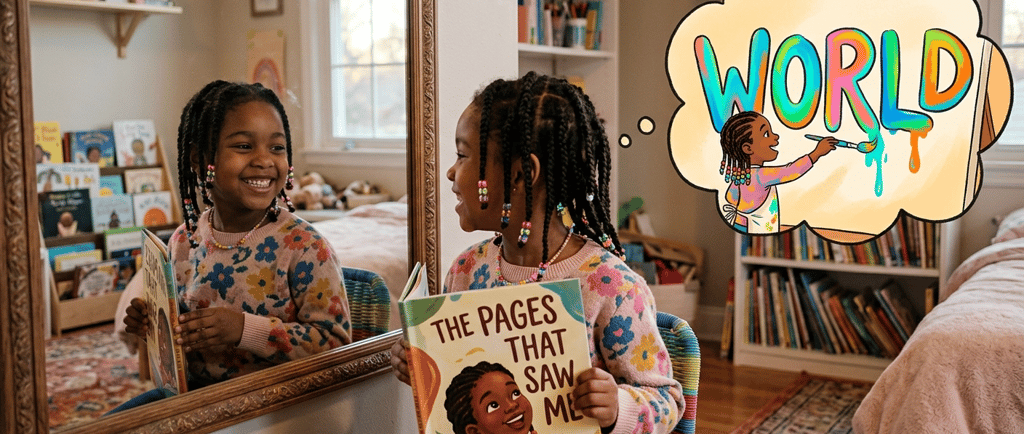
I was 10 years old the first time I saw myself in a book.
The book was Jubilee by Margaret Walker — a sweeping story of a Black woman's journey through slavery, the Civil War, and Reconstruction. I wasn't just reading it. I was inside it. For the first time in my young reading life I wasn't an observer peering in from the outside. I was an insider — and the feeling was indescribable.
That moment changed everything. It made me actively search for more Black stories, more Black characters, more pages where I belonged. And it planted a seed that would eventually grow into a career dedicated to putting the right books into the hands of children.
That's the power of a mirror.
Dr. Rudine Sims Bishop and the Framework That Changed Everything
In 1990, Dr. Rudine Sims Bishop — one of the most important voices in children's literature — introduced a framework that gave language to something many of us had felt but never been able to articulate. She described books as mirrors, windows, and sliding glass doors.
I had the privilege of meeting Dr. Bishop once. Standing in her presence, I thought about every child who had ever needed a mirror and couldn't find one. And every child who had never been invited to look through a window into someone else's world.
Her framework is as urgent today as it was the day she wrote it.
Mirrors: The Magic of Being Seen
A mirror book reflects a child's own life back to them — their face, their family, their culture, their experiences, their language. When a child finds a mirror book they feel seen, valued, and affirmed. They think: someone wrote a story about people like me. My story matters.
I witnessed this firsthand during my years as a first grade teacher.
I had a student — a precious little boy — who was unusually solemn. Quiet in a way that worried me. I read aloud to my class every single day, and I was intentional about choosing books where my students could see themselves — books with characters who looked like them, families that reflected theirs, and experiences that honored their lives.
But every child has a specific mirror waiting for them. And his was Daddy Is a Monster...Sometimes by John Steptoe.
When I finished the last page, he looked up at me with bright, alive eyes and said — "That junk was good!"
It was the first time he had ever responded to anything I read aloud. Four words that stopped my heart.
Why that book? Why that day? Because it wasn't just representation — it was recognition. The specific relationship between a Black father and child, told in a voice and through faces that felt intimately familiar, touched something deep inside him. He wasn't just seen. He was known.
That is what a mirror does.
Windows: Seeing Into Someone Else's World
A window book allows a child to look into a world different from their own — a different culture, a different family structure, a different experience of being human. Window books build empathy, curiosity, and an understanding that the world is wider and richer than what we see every day.
Here's something worth sitting with: Black children grow up surrounded by white cultural references. In books, on television, in classrooms — white experiences are often treated as the default, the universal, the assumed. In many ways Black children have always been looking through windows whether they chose to or not.
But how often do Black children get to peer through the window into the world of the Inuit? Into Southeast Asian traditions? Into Mexican folklore? Into Indigenous stories from the Americas? How often are they invited to revel in shared humanity across cultures, or to celebrate the beauty of difference?
Window books should go in every direction — not just one. Every child deserves to look out and see the whole wide world.
Sliding Glass Doors: Stepping Inside and Dreaming
A sliding glass door book goes one step further than a window. It doesn't just let a child look in — it invites them to step inside, to inhabit another world completely, to live inside a story and be transformed by it.
Sliding glass door books expand what a child believes is possible. They open worlds, spark imagination, and plant the seeds of dreams that might otherwise never take root.
I want to be honest here: books are not a cure for every societal ill. Reading will not instantly erase racism, homelessness, or poverty. It won't solve every hard thing a child faces in this world.
But stepping through that sliding glass door does something quiet and profound. It opens a world of possibilities. It whispers to a child: there is more. You can dream further than you can see.
And we know this to be true — every great moment of change in human history started with someone who dared to dream of something different.
What This Means for the Books You Choose
As parents and caregivers, the books we put in our children's hands are not neutral choices. They are messages. They say: your story matters. Other stories matter. The world is big and you belong in it.
So as you build your child's bookshelf, ask yourself:
Does my child have mirrors — books where they can see themselves?
Does my child have windows — books that open doors into other cultures and experiences?
Does my child have sliding glass doors — books that invite them to step inside and dream?
Every child deserves all three.
At Bonya Books, we are committed to creating resources that honor Black children — their joy, their identity, and their brilliance. Because every child deserves to be an insider. 🌳🖤
Contact
grow@bonyabooks.com
678-383-0502
© 2026. All rights reserved.


Rooted at home. Ready for the world.